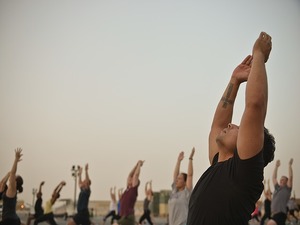
The Importance of At-Work Stretch Breaks

the_importance_of_at-work_122792_225532Many of us have desk-bound office jobs that see us sitting in the same position for hours on end. Usually, this position is hunched over a keyboard and leaning forward slightly to peer at a computer screen. Unfortunately, this poor posture can have serious, long-term impacts on the curvature of our spine, which can lead to chronic back and neck pain, and if left untreated for a long enough period of time, can even lead to permanent damage.

The good news though, is that there’s a simple fix. Simply taking periodic breaks to stretch and move around will help offset the impacts of sitting in that position. You don’t have to take a stretch break every hour, but taking at least a couple a day, even if they’re only a few minutes in duration will go a long way toward relieving tensed and cramped muscles, improving blood flow, and correcting posture.

If you are able, take it to the next level and get up and move. Stretching at the desk is all well and good, but the more you can move during the course of day (especially if you have a desk job), the stronger the effect will be.

The biggest danger here is that by not taking these kinds of “mobility breaks,” you run the risk of muscle cramping and atrophy in the shorter term, and spinal misalignments in the longer, as your back begins to adjust to the “new normal” that is your hunched over sitting position. While these problems can be corrected even if they’ve been ongoing for years, the process of doing so will be longer, and more uncomfortable, possibly even downright painful, until your back has shifted back into its original, natural position and configuration.

While the notion of taking periodic stretch breaks sounds too simplistic to have any meaningful impact, you’d be amazed at the difference they can make. Starting today, try it for yourself and see. You’ll be glad you did.

Suffering From Allergies? Call Your Chiropractor!

suffering_from_allergies__122803_225546When springtime comes, are you one of those unfortunate people who spends the entire season coughing and sneezing? Allergies and allergic reactions are no fun. While generally not life threatening, they can make day to day living a misery. Your eyes water constantly. You seem to cough and sneeze at the drop of a hat. You find yourself reaching for over the counter allergy medicine several times a day, and it helps, but only some. Is there anything else you can do?

Actually, yes there is!

Allergies are your body’s way of expelling things that have gotten into your system that it regards as threats. That’s why your body responds the way that it does. Many people who pay regular visits to their chiropractor, however, have reported a generalized (and often dramatic) improvement in their allergy symptoms.

At first glance, that may seem surprising. It shouldn’t really. Chiropractic therapies do a lot more than just crack your bones. That is, of course, what they’re best known for, but this type of therapy has a lot of other benefits besides better musculoskeletal alignment. For one thing, the therapy provides you with better blood flow and circulation. Here, we’re not just talking about the circulation of your blood, but also of your lymphatic fluids.

Even in people with relatively poor circulation, blood obviously still flows, because your blood supply has an advantage that your lymphatic system does not – the heart is its pumping mechanism. Your lymphatic fluids have no pump, relying on the movement of your body to help circulate those fluids, and your lymphatic system is what’s chiefly responsible for keeping you fit and healthy.

In addition to improving circulation though, chiropractic care also benefits your nervous system. When your spine is misaligned, nerves can become pinched. These pinched nerves send signals through the body that may confuse your immune system into action when it’s not needed. This can cause your immune system to jump at any little intrusion, which of course, makes allergy symptoms worse.

Don’t let allergies get the better of you. There’s a good chance that chiropractic case can reduce, and in some cases, even eliminate them. You’ve got nothing to lose by finding out, and everything to gain.

Replace Snack Cravings With These Healthy Alternatives

replace_snack_cravings_wi_122801_225544In the United States, the hands-down most popular snack is chocolate. We just can’t seem to get enough of the stuff. Unfortunately, as snacks go, all the sugar and fat make it a fairly unhealthy snack. You’re getting a calorie dense snack with virtually no actual nutritional value, which is what dieticians refer to as “empty calories.” Fortunately, there are some great alternatives to our favorite snack food. You don’t have to do without if you want to be healthy, you just have to shift gears a bit. Here are some better, healthier alternatives:

Dark Chocolate

You don’t even have to say goodbye to chocolate forever, but the dark version is much better for you than regular milk chocolate. Loaded with antioxidants and other things your body needs, it’s got a rich, full flavor that many people prefer. As a bonus tip, some people claim it’s a bit of an aphrodisiac.

Go Nuts!

Some people don’t like the texture, but if you’re a nut lover, you’re in luck. You’ve got a wide range of options here. The unsalted varieties are better for you, of course, but in moderation, even the salted varieties are a decent option. Here, your best bets, in terms of both flavor and nutrient punch are almonds, Brazil nuts, and walnuts.

Seeds

Like nuts, most varieties of seeds are extremely good for you, and packed with a surprising nutrient punch. Here, the best in class are sunflower seeds, flax seeds and surprisingly, pumpkin seeds! Enjoy any of these by the handful!

Fruit

Nearly any type of fruit is a good option, and certainly much better than anything you can get out of a box or a can. Fruits are loaded with nutrients you need, and packed with antioxidants, which have all sorts of health benefits for those who eat them. As a bonus, fruits come packed with fiber. While man cannot live on fruit alone, you can’t go wrong by adding them to your diet in abundance.

While there’s no such thing as a completely guilt-free snack, these come as close as you’re likely to get. Mix and match for greater variety and enjoy these healthy alternatives.

How Sitting All Day Can Affect Your Overall Health

how_sitting_all_day_can_a_122804_225547Does your job involve a lot of sitting? If so, you can be damaging your body without even knowing it. Sitting all day can increase your risk of developing serious health issues and decrease your quality of life. Below are some major health issues that can be caused by sitting, and some things you can do to help reduce your risks.

Health Risks of Sitting down All Day

  • Sitting for more than 6 hours a day for 10 years can increase your risk of developing heart disease by 64%.
  • Sitting too much can raise your risk of developing prostate cancer by 30%.
  • Those who set for 6 hours or more a day over the period of 10 years have a 30% higher rate of developing breast cancer.
  • Sitting all day can make you gain unwanted weight which can cause a host of health problems including diabetes.
  • Sitting for long periods of time can increase the chances of developing high levels of bad cholesterol.

Two Things That You Can Do To Stay Healthy

While many of us might not have a choice when it comes to sitting at work there are some things you can do to help you stay healthy. Below are two simple things that everyone can do to stay fit and decrease their health risks at the same time.

1. Stand up and walk around for 10 minutes each hour. This is a great way to get your blood flowing and help you stay healthy. Even if you just walk around your office you should always try to get up from your chair each hour. Surely your boss won’t mind if you do.

2. Get 30 minutes of activity per day. Taking just 30 minutes out of your day to exercise can greatly reduce your risk of developing serious health issues. Brisk walking, working out at the gym or running on your own treadmill are all great ways to get your daily 30.

Now that you know the risks of sitting too long and what you can do to stay healthy at work, why not act? Your health is very important and you should always be proactive about it. If you are a business owner, why not implement a health program to help those workers whose jobs require them to set long periods of time? Not only will you help your workers become healthy, you will also improve productivity and cut down on medical related costs. Start putting what you have learned here to good use today.

Carpal Tunnel – Three Simple Ways To Reduce Your Risk

carpal_tunnel_-_three_sim_122788_225528Carpal tunnel is bad news. It’s something you want to avoid at all costs, because once you have it, it can take a long time for it to go away, and it may require surgery. In the meanwhile though, you’ll suffer a nasty combination of numbness and pain.

Carpal tunnel syndrome is caused when pressure is put on the soft tissue in the wrist which cuts off the blood supply to nerve endings. If caught right away, when the first signs of numbness present themselves, it’s usually easily reversible, but if left unchecked, that’s when surgery may be required. Fortunately, there are a few simple things you can do to reduce your risks. Here are the three things that make the biggest difference:

Regular Breaks Matter

You don’t even have to get up from your chair, but you absolutely should take a break from your work and perform a series of wrist bends and stretches in order to keep them limber and flexible.

Ergonomics is Everything

The phone on your desk, your keyboard, and your mouse should all be within easy reach. No more than the length of your forearm in distance from your body. You’re going to want to adjust the height of your chair so that when you are seated at your desk, your forearms are level with your keyboard. In this configuration, you won’t have to bend or flex your wrists when you type.

Keyboard Pads

You may have seen these on the keyboards of people you work with. These are long strips of foam that run along the bottom edge of your keyboard. Consider them to be “palm pillows.” They cushion you’re the heels of your palms, preventing the nerves in your wrist and hands from getting squeezed.

If you follow these three simple strategies, you won’t reduce your risk of getting Carpal tunnel to zero, but you’ll go a long way toward that goal. Your wrists will thank you for it.

3 Fabulous Exercises To Help With Back Pain

3_fabulous_exercises_to_h_122791_225531Every year, three out of four Americans will wind up paying a visit to their doctor because of back or neck pain. In the “good ol’ days,” most doctors prescribed bed rest for those times when your back was giving you trouble, but these days, science has changed the direction of the prevailing wisdom. We now know that bed rest is probably the worst thing you could do, and exercise is the surest and fastest way to get your back, back to normal.

Of course, not just any exercise will do. If you’re already in pain, then you’ve got to be careful with how you work those tender muscles. The exercises below are among the best choices for people suffering with back pain to help speed healing, and get you back to enjoying a pain free life.

Spinal Stretch

This one is a nice way to warm up and cool down. It’s low-intensity, and works most of the muscles in your back, so wherever your pain is centered, this one will help. Lie on a back with a pillow or other cushion under your head. Bend your legs at the knee, with your knees pressed together. Breathe slowly and deeply, and as you exhale, twist at the waist, rolling your knees until they touch the floor (or as close as you can get). Hold, and then return to the upright position, repeating on the next exhale. Start with five reps to one side, then switch and do five reps to the other.

Lower Back Stretch

This one is especially helpful for people suffering with lower back pain, but of course, it will provide some generalized benefit to any back pain sufferer. Begin on all fours, with your knees directly under your hips, and your hands directly under your shoulders. Your spine should be in its natural, “neutral” position. Your head should be held slightly up, so that it is in line with your spine, shoulders back, and elbows not locked. Breathe deeply, and on the exhale, slowly rock backwards from this position, buttocks toward heels. Hold for thirty seconds, then return to the starting position. Begin with five reps, working up to more as comfort allows.

Bird Dog

Another fantastic, general purpose stretch that gently works all the major muscles of the back. Begin on all fours, positioned as described in the Lower Back Stretch, above. Breathe deeply, and on the exhale, extend one leg, and the opposite arm out straight (or as straight as you’re able), running in a line with your spine. Hold this position for 5-10 seconds, then return to your starting position. On the next breath extend the other arm and leg. Try for ten reps (five per side), building on that number as comfort allows.

Using just these three exercises, you’ll be able to quickly, and in a low-impact manner, work those aching muscles, ease your pain, and restore greater mobility. Given time and consistent use, these stretches can get you fully back on your feet again.

Five Tips For Better Office Posture and Health

office-1078869_640How many hours a day do you spend hunched over your computer, smartphone, or tablet at your desk? When you stop to think about it, the number will probably shock you, and it’s all but certain that your posture isn’t picture perfect, which unfortunately, can lead to back and neck pain over time if you’re not careful. Fortunately, this is an entirely fixable problem. Here are five quick tips you can use, starting right now, to improve your posture and minimize your risk of back or neck injury.

Take Short Breaks Throughout The Day

Let’s start with the simplest and most basic thing. Put yourself on a schedule, and take regular walking breaks. They don’t have to be very long, even five minutes will do. The main point is to simply make time for it. Bonus tip: If you start drinking more water, you’ll have to go to the bathroom more often, and you won’t have to rely on technology to remind you. Your bladder will take care of that.

Better Back Support

Sometimes the best solutions are also the simplest. The reality is that office chairs (even really expensive ones) aren’t all that comfortable. After a few hours, it feels like you’re sitting on concrete blocks. A simple solution is to add a lumbar pillow for extra support for your lower back. They’re quite inexpensive, and dramatically increase your comfort, while automatically improving your posture.

Be Mindful

If you’re not thinking about your posture, you’re going to slouch. The reason? Your body doesn’t like being uncomfortable, and you’ve spent so much time standing and sitting in poor posture positions that your body has gotten used to it, so of course, it becomes the new normal. Reverse that trend by being aware of your posture as you’re working. You don’t have to think about it on a constant basis, but be mindful of it, and keep your shoulders back, and your ears in line with your shoulders. You’ll be amazed at the difference this small change can make.

Uncross Those Legs

Few things are worse for your back than sitting with your legs crossed. This is another quick, easy change to make that will dramatically improve your posture and reduce the chances of back trouble later on.

Neck and Shoulder Exercises

If you’ve ever been to a chiropractor, you already know these exercises. Several times a day, gently roll your shoulders, expanding your chest out and holding that position, then completing a shoulder rotation. Do a quick set of ten reps, then simply turn your head left to right, rotating it as far as you can and holding for a few seconds before rotating back the other direction. Again, a quick rep of ten a few times a day will keep your neck and shoulders flexible.

By using these few simple tips you can increase your comfort, reduce strain and pains, get better circulation, and be well on your way to better health. Try a couple of these and see if it makes a difference in your well-being throughout the work day.